

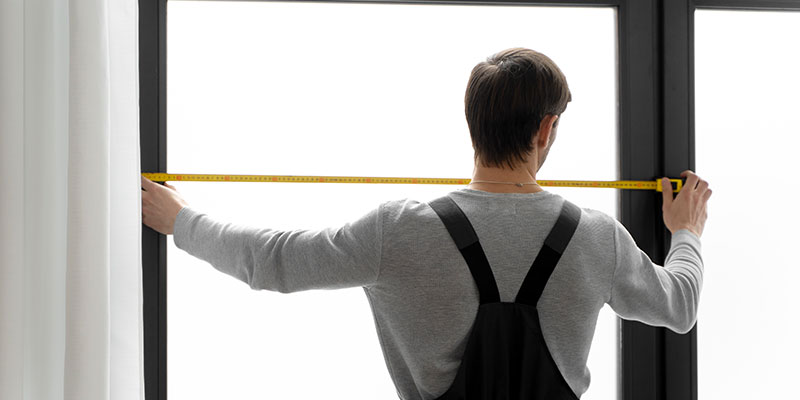
Wrong measurements are the most common reason a new pair of curtains looks off. Our workshop in Musaffah, Abu Dhabi cuts and stitches made to measure curtains for homes, villas, offices and hotels, and every cut, seam and hem is checked before it leaves. This guide shows the simple way to measure your own windows before you order. If you want your sizes checked, send them on WhatsApp or use our contact page.
Why measuring well matters
Curtains that are too short look like a mistake. Curtains that are too narrow look thin and let light in at the sides. Curtains that are too long drag on the floor. Most of these problems start with the measurements, not the fabric. Ten minutes with a tape measure can save you a remake.
What you need
- A steel tape measure. Cloth tapes stretch and give wrong numbers.
- A notebook or your phone to write the sizes in centimetres.
- A stable ladder or stool.
- A second person for wide windows and sliding doors.
Step 1: Decide where the rail will go
Curtains hang from a rail, track or pole, so you measure from where it will be fixed, not from the window frame. Decide first whether it goes on the wall above the window or on the ceiling. A ceiling track, or a rail fixed high on the wall, makes the window look taller.
The style matters too. Wave curtains need a wave track, and eyelet curtains need a pole that fits through the eyelets. Pleated curtains hang from hooks on a pole, rings or a track. Know which one you want before you start measuring.
Step 2: Measure the width
Measure the length of the rail or track, not the glass. If the rail is not installed yet, decide its length now. As a general rule, the rail should extend about 10 to 20 cm beyond the window frame on each side. This lets the curtains stack beside the window when open, so they do not cover the glass and block light.
Write the rail width down and label it clearly.
Step 3: Measure the drop
The drop is the length from the rail to where the curtain ends. Measure from the rail, or from the top of the pole, down to your chosen finish point. You have three common choices.
- Floor length. The curtain stops about 1 to 2 cm above the floor, so it moves freely and stays cleaner. This is the most popular choice.
- Sill length. The curtain stops just below the window sill. It suits kitchens, desks and windows with furniture underneath.
- Floor touching. The curtain rests lightly on the floor. It looks fuller but collects more dust.
Measure the drop on the left, in the middle and on the right. Floors and ceilings are not always level, and a difference of a centimetre or two is common. Write all three numbers down and give them to us, and we confirm which to use before we cut.
Step 4: Understand fullness
The fabric in a curtain is wider than the rail. This is called fullness, and it is what makes the folds look rich instead of flat. Most curtain styles need fabric about 1.5 to 2.5 times the rail width, depending on the heading and the fabric. Sheers look best at the fuller end.
You do not need to calculate this yourself. We work out the fabric width for your style when we confirm your measurements.
A worked example
Say a living room has a sliding door and a window side by side, and together they span 3.2 metres. This is an illustration, not a specific customer.
- Rail width. Add 15 cm on each side, so the rail is 3.5 metres.
- Drop. The ceiling track sits 2.75 metres above the floor, and you want the curtain 1.5 cm above the floor, so the drop is about 2.73 metres.
- Fullness. At 2 times fullness, the fabric width is about 7 metres, which can be split into two panels.
Those three numbers are what the workshop needs to start planning your curtains.
Mistakes to avoid
- Measuring the glass only. The rail decides the curtain width, not the glass.
- Measuring once. Measure twice, and measure the drop in three places.
- Forgetting what is in the way. Air conditioning units, vents, ceiling bulkheads, curtain boxes and furniture can limit where the rail goes and how long the curtain can be. Note them down.
- Mixing units. Use centimetres for everything and write the unit next to each number.
- Ignoring light gaps for blackout curtains. Light enters at the sides and top, so go wider and higher than the window. Our blackout curtains page explains more.
Can Skyline Curtains check my measurements?
Yes. Measurement is a step in our process, and we confirm the details before we cut. Send your sizes and a photo of the window on WhatsApp, or tell us about your project through the contact page, and our team will tell you if anything needs adjusting. Ask us how measurement works for your project when you get in touch.
Frequently asked questions
Measure the length of the rail or track where the curtain will hang, then measure the drop from the rail to where you want the curtain to end. Do not measure the glass. Write both numbers in centimetres.
The rail should extend about 10 to 20 cm past the window frame on each side, so the curtains stack beside the glass when open. The curtain fabric itself needs to be about 1.5 to 2.5 times the rail width, depending on the style, to look full.
Most floor length curtains stop about 1 to 2 cm above the floor. Sill length suits kitchens and desks, and floor touching curtains look fuller but gather more dust. Choose the finish point before you measure the drop.
Yes. Skyline Curtains in Musaffah cuts and stitches made to measure curtains for homes, villas, offices and hotels in Abu Dhabi. Send your sizes through WhatsApp or the contact page and the team will confirm them before cutting.
Conclusion
Measure the rail, not the glass. Measure the drop in three places, choose where the curtain ends, and let the workshop handle the fullness. Accurate numbers are the simplest way to get curtains that hang right the first time.
If you want a second pair of eyes on your measurements, message Skyline Curtains on WhatsApp, call +971 50 123 5952, or visit our workshop in Musaffah, ICAD I, Abu Dhabi.